
Published: 8 September 2025
By: StudyAML
The global push to bring digital assets into regulated financial channels took another important step forward with the Wolfsberg Group’s release of its Guidance on the Provision of Banking Services to Fiat-Backed Stablecoin Issuers. The document provides banks with practical expectations for managing AML/CFT and sanctions risks when onboarding and maintaining relationships with stablecoin issuers.
As stablecoins continue to gain traction—both as payment instruments and settlement tools—the need for consistent global standards has become urgent. The Wolfsberg Group, representing 12 leading international banks, aims to fill critical gaps by outlining a risk-based framework adaptable across jurisdictions.
Why the Guidance Matters
Fiat-backed stablecoins have become central to the digital-asset ecosystem. They serve as an entry point for consumers, a settlement layer for exchanges, and a liquidity tool for institutional investors. But they also present unique risks:
- Opaque reserve structures
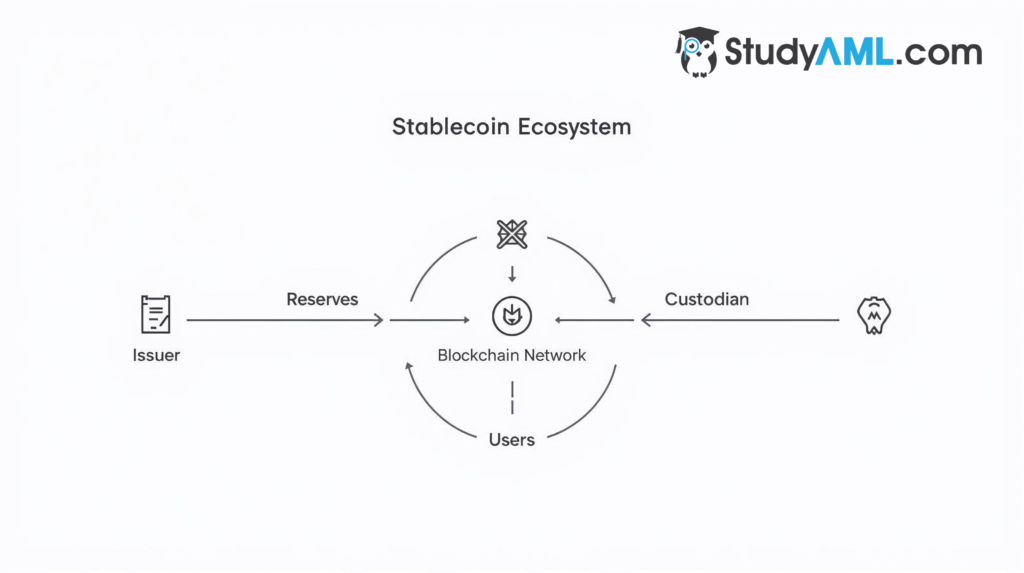
- Complex issuer–trust–custodian arrangements
- Rapid, high-velocity transactions across borders
- Potential exposure to unregulated VASP ecosystems
Until now, banks lacked a unified view of how to assess and monitor these risks. The Wolfsberg publication helps fill that gap, offering practical, globally aligned expectations to support safe integration of stablecoins into traditional banking.
Key Elements of the Wolfsberg Guidance
1. Comprehensive Due Diligence on Issuers
Banks onboarding stablecoin issuers should understand the full operational model, including:
- The legal structure of the issuer
- The regulatory status in relevant jurisdictions
- Reserve management practices
- Third-party custodians, trustees, auditors, and administrators
- Redemption mechanisms and transparency obligations
This aligns with FATF’s risk-based approach to VASPs and promotes visibility across the entire issuance chain.
2. Reserve Asset Verification
Given that fiat-backed stablecoins promise a 1:1 backing with cash or cash-equivalents, the Wolfsberg Group stresses:
- Independent audits
- Clear segregation of client assets
- High-quality, liquid reserves
- Frequent attestations and disclosure to users and regulators
Banks must ensure that reserve claims are credible and supported by robust controls.
3. Ongoing Monitoring and Transaction Oversight
Stablecoin issuers often operate at scale and speed, making monitoring essential. Wolfsberg highlights the importance of:
- Continuous transaction-monitoring
- Screening of wallet addresses and counterparties
- Monitoring flows to and from VASPs
- Escalation procedures for red flags
- Integration of blockchain analytics
Banks are encouraged to use advanced surveillance technologies capable of handling on-chain and off-chain activity.
4. Sanctions & Cross-Border Risk Management
Stablecoins can travel across borders rapidly, raising sanctions-evasion concerns. The guidance calls for:
- Real-time sanctions screening
- Visibility into the stablecoin’s distribution network
- Controls to identify usage in high-risk jurisdictions
- Review of issuer policies for blacklisting or freezing non-compliant wallets
This reflects increasing global enforcement scrutiny around sanctions-related failures.
5. Governance, Controls, and Transparency
The Wolfsberg Group expects issuers to implement strong governance practices, including:
- Clear accountability structures
- Documented AML/CFT frameworks
- Independent compliance oversight
- Transparent reporting to users and partners
Banks should assess whether senior management actively oversees the stablecoin programme and risk management.
Implications for Banks and Regulators
The guidance signals several global trends:
Traditional banks are increasingly expected to support digital-asset infrastructure.
Regulators are moving toward integration rather than exclusion — provided risks are properly managed.
AML/CFT standards for stablecoins are converging.
Globally aligned expectations from the Wolfsberg Group, FATF, and IOSCO suggest that uniform regulatory frameworks are no longer distant.
Banks must build digital-asset compliance capability.
From blockchain analytics to wallet-level monitoring, institutions that want to service this sector need upgraded technology and skills.
What This Means for Compliance Teams
For AML/CFT professionals, the Wolfsberg guidance should trigger immediate considerations:
- Do we have the tools to monitor on-chain activity?
- Can we evaluate whether a stablecoin is genuinely fully backed?
- Do we understand the issuer’s ecosystem (administrators, custodians, exchanges)?
- Are our sanctions controls sufficient for high-velocity stablecoin flows?
- Do our risk-rating models accurately capture VASP-related exposure?
AML teams should review their frameworks and update procedures, training, and due-diligence checklists accordingly.
A Step Toward Safer Digital Finance
The Wolfsberg Group’s guidance offers a practical, risk-based blueprint for banking stablecoin issuers. As regulators worldwide accelerate work on digital-asset frameworks, this document will likely shape supervisory expectations and industry best-practice.
For compliance teams and financial institutions, the message is clear:
Digital assets are no longer peripheral — they are a core part of the financial ecosystem, and risk management must evolve accordingly.